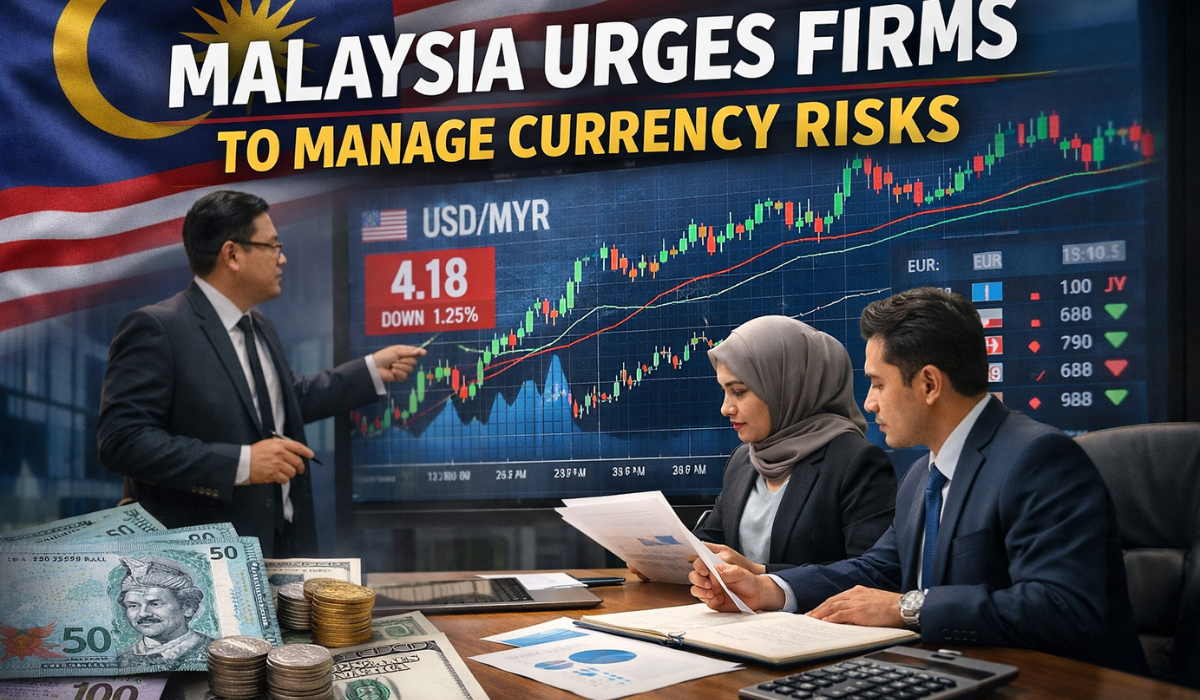
Companies in Malaysia are advised to actively manage currency risks through proper hedging and business strategies, said Investment, Trade, and Industry Minister Datuk Seri Johari Abdul Ghani.
He explained that ringgit fluctuations are a normal part of the economic cycle, with their impact varying across industries based on business models and market exposure.
“While currency movements can create challenges for some businesses, they also present opportunities for others. Companies must adopt effective strategies such as hedging, supply chain protection, and customer management to mitigate risks,” he said.
Johari made these remarks during the official launch of the GD XCHANGE Experience Centre in Kuala Lumpur on Tuesday, following questions about the ringgit’s strengthening, which recently hit 3.9 against the US dollar for the first time in seven years.
Impact on Different Business Sectors
The Minister noted that the effects of currency movements differ by sector. For instance, commodity-based and consumer-focused businesses need distinct approaches to managing foreign exchange risks.
On Malaysia’s recent Agreement on Reciprocal Trade (ART) with the US, Johari described it as a pragmatic step to avoid higher tariffs and protect national economic interests.
“Signing the agreement gives Malaysia space to negotiate terms and prevents immediate tariff hikes that could affect exports and the broader economy. The government carefully weighed the costs and benefits, and the agreement also includes an exit clause if it no longer serves Malaysia’s interests,” he added.
The Minister emphasized that the government’s priority is to protect businesses operating in Malaysia and maintain the resilience of the economy.
Stronger Ringgit Seen as Positive for GDEX
Cost Efficiency and Talent Retention Benefits
GDEX Bhd managing director and CEO Teong Teck Lean welcomed the stronger ringgit. He explained that it reduces costs for services priced in US dollars, such as software licences and technology subscriptions, and improves cost efficiency for the company.
“A stronger ringgit also helps retain talent, as wage gaps with neighboring markets narrow slightly, reducing incentives for staff to move abroad,” Teong said.
He added that the currency shift supports core operations and technology spending, with no major downside to the group’s business model.
GDEX chairman Tan Sri Muhammad Ibrahim was also present at the launch.
GD XCHANGE: Driving Technology Transformation
GD XCHANGE, the technology arm of GDEX, marks the group’s evolution from a traditional courier and logistics provider into a fully integrated, tech-driven logistics ecosystem.
The platform combines global technology principals, channel partners, and resellers, covering areas such as:
- Supply chain and commerce solutions
- Cybersecurity and cloud subscriptions
- Smart devices and connectivity
- Workspace solutions
- Electric vehicle ecosystem support
Johari highlighted GD XCHANGE as a model for innovation in Malaysia’s logistics and technology sectors.